
The Invisible Architecture of a Backyard
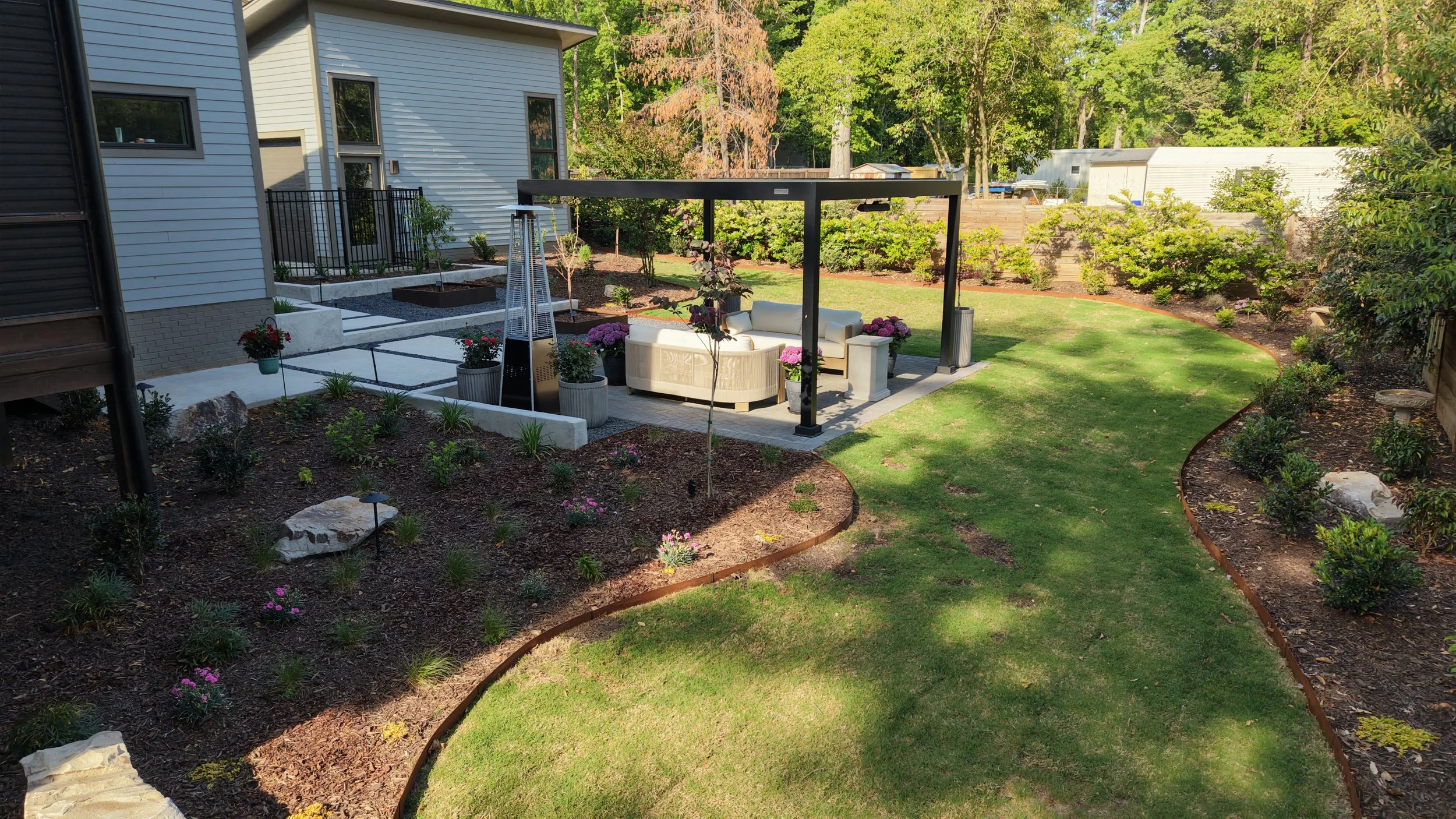
Most people look at a backyard and see what's there: a patio, a lawn, a few trees, a retaining wall, or a garden bed. But great outdoor spaces are rarely defined by the individual features you can see. They're defined by how everything flows together.
Have you ever walked into someone's backyard and immediately felt like it was larger, more inviting, or somehow more relaxing than your own? Maybe the property wasn't particularly big, and perhaps it didn't even have expensive materials or elaborate landscaping. Yet something about the space just felt right.
That is something you achieve on purpose.
Behind every well-designed outdoor space is an invisible framework that influences how we move, where we look, where we gather, and how comfortable we feel. It's the thoughtful arrangement of elevations, pathways, sightlines, boundaries, and transitions that transforms an ordinary yard into something memorable.
This...is the invisible architecture of a backyard, and it's one of the most overlooked aspects of landscape and hardscape design.
Let's take a closer look at what makes certain outdoor spaces work so well, and how a few thoughtful design decisions can completely change the way you experience your own backyard.
Why Some Backyards Feel Bigger Than They Actually Are
One of the most interesting things about landscape design is that the size of a property doesn't always determine how spacious it feels.
In fact, a smaller backyard can sometimes feel much larger and more interesting than a property with twice the square footage. The secret often comes down to how the space is organized.
It's Not Always About Square Footage
Think about walking into a large, completely open backyard. There's plenty of room, but everything is visible at once. There's no real sense of discovery, no distinct areas, and nowhere that stands out as special.
Now imagine a backyard with a winding walkway, a secluded seating area, some strategically placed privacy shrubs, and a patio that sits slightly above the surrounding lawn.
Although the second yard might be smaller, it offers more visual interest and a stronger sense of purpose.
This is because our brains don't experience outdoor spaces simply by measuring their dimensions. We respond to visual boundaries, depth, perspective, and the way different areas connect.
A well thought out landscape can use these elements to create the impression of more space without adding a single square foot.
Creating Depth Through Landscape Design
There are several ways to make a backyard feel more expansive:
Layer your landscaping: Combining plants of different heights and textures creates visual depth. Instead of seeing one flat planting bed, the eye moves through the different layers.
Use curved pathways: A gently winding walkway can make a yard feel like it continues beyond what you can immediately see.
Create focal points: A statement tree, water feature, stone wall, or seating area gives the eye somewhere to travel.
Frame your views: Trees, shrubs, and architectural features can direct attention toward certain areas while allowing other parts of the yard to remain partially hidden.
Avoid revealing everything at once: A little mystery can make a landscape more engaging. Sometimes the best outdoor spaces invite you to explore them.
The goal isn't to make a backyard look artificially larger. It's to make every part of the available space feel intentional.
How Elevation Changes Create Distinct Outdoor Rooms
Here's something many homeowners don't consider when planning a backyard renovation: a yard doesn't have to be completely flat to be functional.
In fact, changes in elevation can be one of the most valuable design opportunities on a property.
A sloping backyard might initially seem like a limitation, but with some grading, retaining walls, steps, and terraces, that same slope can become the foundation for a much more interesting outdoor environment.
Think of Your Backyard as a Collection of Rooms
Inside your home, different rooms serve different purposes. You have a kitchen for cooking, a living room for relaxing, and perhaps a dining room for entertaining.
Outdoor spaces can work the same way.
Instead of treating the entire backyard as one large area, consider creating distinct outdoor rooms:
A patio for dining and entertaining.
A lower terrace for relaxing around a fire feature.
A garden area that provides a quieter, more private retreat.
A raised seating area that offers a different perspective of the property.
An open lawn that provides room for recreation.
These areas don't necessarily need fences or permanent walls to feel separate. Changes in elevation, paving materials, landscaping, and the arrangement of seating can establish natural boundaries.
Why Retaining Walls Are About More Than Holding Back Soil
Retaining walls are often viewed as purely functional structures, but they can play a much bigger role in backyard design.
A thoughtfully designed retaining wall can:
Establish different levels for different outdoor activities.
Create multiple usable, level areas on sloped properties.
Frame patios and outdoor seating areas.
Introduce structure and definition to an otherwise open landscape.
Help smooth out changes in grade and appropriately direct surface water when properly designed.
In the right setting, a retaining wall becomes part of the architecture of the backyard rather than simply a solution to a grading problem.
This is where landscaping and hardscaping really begin to work together!
Why the Transition From House to Yard Matters
One of the most overlooked parts of outdoor living is the transition between the home and the landscape.
Consider how you step outside your back door. Does the patio feel like a natural extension of your home, or does it feel like you've stepped into a completely separate space?
That transition matters more than most people realize.
A well-designed outdoor living space should feel connected to the architecture and personality of the house. The materials, layout, proportions, and pathways should all contribute to a natural flow between indoor and outdoor environments.
Creating a Natural Connection
Here are a few ways to make that transition feel more intentional:
1. Pay attention to materials.
Consider how the colors and textures of your home's exterior relate to the patio, walkways, and surrounding landscape. The materials don't have to match perfectly, but they should complement one another.
2. Make the entrance feel inviting.
The area immediately outside a back door sets the tone for the entire outdoor experience. A thoughtfully sized patio or landing can make stepping outside feel effortless.
3. Think about movement.
People should be able to move naturally between the kitchen, patio, yard, and other outdoor areas. Awkward turns, narrow passages, and poorly positioned steps can interrupt that experience and even discourage people from entering that space.
4. Consider the view from inside.
Your backyard should look intentional even when you're enjoying it from the kitchen window or living room. Think about what you see when looking outside, not just what the space looks like when you're standing in it.
The best outdoor spaces don't feel like an addition to the home. They feel like they were always meant to be there.
How Pathways Influence Where People Naturally Walk
Have you ever noticed how people tend to create their own shortcuts across a lawn, even when a perfectly good walkway is nearby?
This happens all the time!
People naturally choose routes that feel convenient, comfortable, and intuitive. That's why pathway placement is about much more than simply connecting two points.
A walkway helps establish how people experience a property. It can encourage movement toward certain features, separate activity areas, and create a sense of direction throughout the landscape.
Designing Pathways That Make Sense
When planning backyard walkways and landscape pathways, consider these important details:
Follow natural movement patterns: Think about where people actually need to go. A walkway should connect frequently used areas rather than force people to take a detour.
Create visual destinations: A pathway leading toward a seating area, garden, or outdoor feature gives the space a sense of purpose.
Consider the width: A narrow path might work well in a garden, while a walkway connecting the house to a main patio should comfortably accommodate everyday traffic.
Use curves intentionally: Curved pathways can soften the appearance of a landscape and create a sense of discovery, but unnecessary curves can make a route less practical.
Choose materials that complement the setting: Natural stone, pavers, gravel, and concrete each create a different visual and physical experience.
A pathway should feel like a natural part of the landscape, not something that was added simply because there was an empty space to fill.
Five More Design Details That Make a Bigger Difference Than You Think
Sometimes, the most successful landscape designs aren't the ones with the biggest features or the most expensive materials. They're the ones that get the smaller details correct.
Here are five additional considerations that can dramatically improve the way a backyard looks and functions.
1. Give the Eye Somewhere to Rest
A backyard doesn't need to be filled with features from one end to the other.
In fact, too many competing elements can make a space feel cluttered. Open areas between planting beds, patios, and landscape features allow the eye to rest and help individual elements stand out.
Negative space is a key part of good design.
2. Think About What You See From Every Angle
A patio might look beautiful when viewed from the back door, but what does it look like from the far end of the yard?
Good landscape design considers multiple perspectives.
Think about how trees, retaining walls, seating areas, and other features look from different locations. A well-placed focal point can make an ordinary view feel much more intentional.
3. Use Lighting to Create a Second Landscape
Outdoor lighting shouldn't be limited to illuminating walkways and preventing people from tripping.
When used thoughtfully, landscape lighting creates depth, highlights architectural details, and gives the backyard an entirely different personality after sunset.
Consider illuminating:
Stone retaining walls and architectural features.
Statement trees with interesting shapes or branching patterns.
Walkways and stepping stones.
Outdoor seating and gathering areas.
Subtle transitions between different landscape levels.
A backyard should also be enjoyable after dark.
4. Don't Ignore the Practical Side of Beauty
Some of the most important parts of a landscape are the ones homeowners never notice when everything is working correctly.
Proper grading, drainage, soil conditions, and construction techniques all influence the long-term performance of an outdoor space.
For example, a beautiful patio won't be very enjoyable if water consistently collects around the seating area. Likewise, a retaining wall needs proper design and construction to perform as intended.
Good landscape design considers what you see and what happens beneath the surface.
5. Design for How You'll Actually Live
This might be the most important consideration of all.
Before choosing materials or deciding where to put a patio, think about how you want to use your backyard.
Do you enjoy hosting family and friends? Do you want a quiet place to relax after work? Would you rather have an open area for children and pets, or a more intimate outdoor retreat?
There isn't one perfect backyard design.
The best design is the one that reflects the people who live there.
The Best Backyard Designs Are Felt Before They're Noticed
When you walk into a thoughtfully designed outdoor space, you might not immediately recognize why it feels so inviting.
You probably won't stop to admire the exact placement of a retaining wall or analyze the relationship between a walkway and a seating area.
You'll simply enjoy being in that space.
You'll naturally follow the pathway, find a comfortable place to sit, appreciate the view, and perhaps spend a little longer outside than you originally planned.
That's the beauty of the invisible architecture of a backyard.
It's the combination of thoughtful planning, landscape design, hardscaping, elevation, and the little details that make an outdoor space feel complete.
A great backyard isn't necessarily the biggest one, the most expensive one, or the one with the most features. It's the one where everything has a purpose.
And sometimes, the most impressive part of a landscape is everything you don't immediately notice.
By: Lucio S.